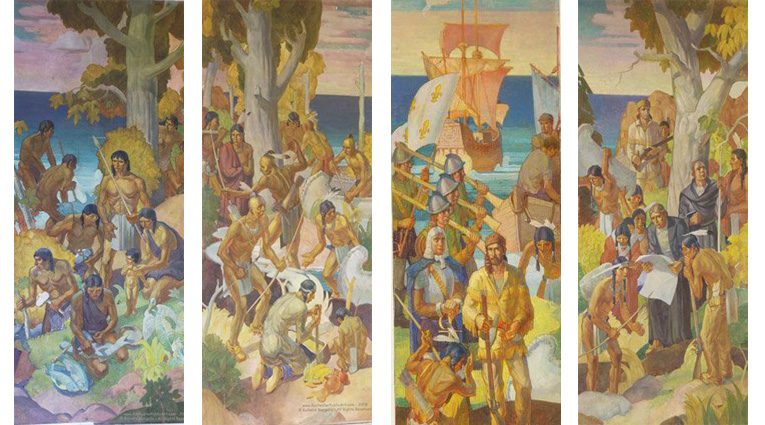
Carl Peters' WPA Murals at Charlotte High School in Rochester, NY.
Life, Liberty, and the Pursuit of Art
Recently, public art has come under intense scrutiny, but not necessarily in a good way. To popular dismay, government agencies now closely examine museums, performing arts centers, national park exhibits, and even roadside historic markers to search for DEI violations. This has led to the editing, closure, or outright elimination of many public art installations and institutions.
It wasn’t always this way. During the Great Depression the New Deal launched the “Federal Art Project” as part of the Works Progress Administration (WPA), providing employment for thousands of artists. These artists were commissioned to create public art for schools, hospitals, and post offices. More than 5,000 artists were contracted during the 1930s and 1940s, resulting in approximately 2,500 murals and thousands of additional artworks that enhanced public spaces across the nation.
The murals and other large-scale works produced under the WPA depicted scenes of everyday American life and often highlighted the history of local communities. Among the prominent artists involved were Thomas Hart Benton, Ben Shahn, and Carl W. Peters, who hailed from Fairport, New York.
An example of WPA art can be found at my old high school, Charlotte High School in Rochester, NY, where eight of Carl Peters’ murals still stand. Painted in oil on canvas in 1942, each mural measures 19 feet in height. These works illustrate Peters’ vision of the Lake Ontario region’s history, beginning with its original Native American inhabitants and continuing through America's “discovery” by Christopher Columbus and Christian missionaries' efforts to convert Native Americans. The prism of the time in which these were painted reflects the historical perspective of the Native American experience in the mid-20th century.
The works created by WPA support the prevailing historical perception of Native Americans, workers’ rights, and public opinions of the times. Whatever revision our current perceptions may have in their historical context, the beauty and craftmanship of the work still serves as inspiration.
Today, it is difficult to imagine government support for the arts like the WPA on such a grand scale. This is especially unfortunate, given that art, music, and theater possess the power to heal and unite.
In any era, it's nearly impossible to separate artistic expression from the life and times in which it is created. It's a reflection of our beliefs, our fears, our joy and our dreams. So, we cherish the freedom to create art that reflects our interpretation of the world around us. Visit a museum, attend a symphony, explore an art gallery. Let’s all be hopeful that the future will be a little kinder to the arts.